In lamenting a particularly frustrating portion of my work as a research scientist, I once described a group of my assignments as "The Rumpelstiltskin Effect". I felt as though in moving my project forward I was being asked to spin straw into gold - a task that was in every way something that nobody could do, but still I was pursuing it. Needless to say, that project did not pan out as well as some of my others.
Reflecting on that portion of my work, I also realized that I've never reviewed and analyzed the popular Brothers Grimm story
Rumpelstiltskin. As many know the story begins with the Sisyphean task for the miller's daughter all because of something her father says:
"Once there was a miller who was poor, but who had a beautiful daughter. Now it happened that he had to go and speak to the king, and in order to make himself appear important he said to him, 'I have a daughter who can spin straw into gold.'"
Notice that the problems all begin because the man was trying to "appear important". The adage of pride before the fall comes to mind here as the story is set in motion. The greedy king locks the girl up with a room full of straw and a spinning wheel and threatens to kill her if she cannot perform the feat by morning. Partly I wonder if this was the king simply trying to call the man's bluff. I have to wonder if the king would really go through with executing a subject - and a beautiful one at that - for what seems to be an obvious exaggeration. So the miller's daughter is more than a little bit stuck. The story tells us:
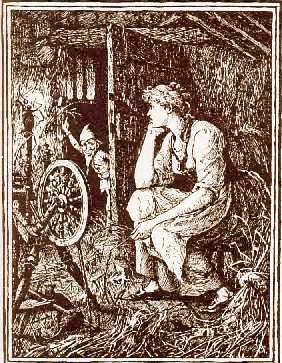
"She had no idea how straw could be spun into gold, and she grew more and more frightened, until at last she began to weep. But all at once the door opened, and in came a little man..."
I'll try not to roll my eyes at why the miller's daughter didn't at least start trying to spin her straw, plead hay fever and demand release, or fess up to her father's lies; but as in many fairy tales, we have a male who comes to her rescue. The stranger creates the gold in exchange for a necklace and when the king's greed causes a repeat of events the miller's daughter turns over a gold ring. (
Does anyone ever stop to wonder why, if the miller was so poor, does his daughter have a necklace and a ring that become some pretty hefty bargaining chips? Or why, if Rumpelstiltskin can spin stray into gold, does he have need of the girl's trinkets? Sorry, moving on.) On the third night, the girl is once more thrust into a room of straw and told by the king, "You must spin this, too, in the course of this night, but if you succeed, you shall be my wife."
Rumpelstiltskin appears to save her once more but she is left without anything to offer him in trade for his service - and yet he offers her a deal:
"'Then promise me, if you should become queen, to give me your first child.'"
Who knows whether that will ever happen, thought the miller's daughter, and, not knowing how else to help herself in this strait, she promised the manikin what he wanted, and for that he once more spun the straw into gold."

I know fairy tale heroines are not known for their brains but since the king promised to marry her for one more night of spinning and if Rumpelstiltskin had already delivered a straw to gold transmogrification twice, why didn't she think she would be queen? So the story proceeds with the girl marrying the king, and eventually having a child that Rumpelstiltskin comes to claim. She pleads with him not to take the baby and he offers her a reprieve if she can guess his name. (
I have to wonder, how did he help her out three nights in a row and she never asked who he was?) Of course the big "R" is not a name on anyone's lips so the new queen's situation is rather dire. She sends out messengers to seek new names from all the kingdoms and eventually one returns with the following tale of what he observed:
"Round about the fire quite a ridiculous little man was jumping, he hopped upon one leg, and shouted -
'To-day I bake, to-morrow brew,
the next I'll have the young queen's child.
Ha, glad am I that no one knew
that Rumpelstiltskin I am styled.'"
The queen reveals the answer to the guessing game and the peeved little man suffers a rather disastrous fate:
"...in his anger he plunged his right foot so deep into the earth that his whole leg went in, and then in rage he pulled at his left leg so hard with both hands that he tore himself in two."
Typically Grimm, that line is the morbid end to the story. At first, my reaction to this story is one of disdain. None of the characters are exceptionally virtuous, but on second look there are some actual morals to be found. The first may be that honesty is the best policy and that one should not tell lies to make themselves seem more important, but I think the larger lesson revealed is to guard one's words.
There are multiple Biblical proverbs about this topic, and regardless of your thoughts on the divinity of scripture, the advice is exceptionally wise. One example is Proverbs 13:3 "
He who guards his lips guards his life, but he who speaks rashly will come to ruin." (18:21 says, "
The tongue has the power of life and death" and 21:23 states, "
He who guards his mouth and his tongue keeps himself from calamity.") Knowing that the Grimms were in the practice of moralizing, I think it can be rather obvious how these verses tie into the tale.
Firstly, the father's boastfulness is what begins the whole fiasco. The king's harsh threats cause the miller's daughter her panic, which in turn leads to her making an unwise promise to Rumpelstiltskin. All through the story we see the characters causing their own trouble because of what they say and ultimately, it is the little man's words when he thinks no one can hear him that leads the queen to have his name.
What are your thoughts on the morals and lessons of Rumpelstiltskin? Is discretionary speech a good theme to pull out of this tale or do you interpret it differently? Do you feel bad that things ended so poorly for the titular character or do you think he got what he deserved?
This post marks another entry in my
2011 Fairy Tale Challenge (10 out of 12) hosted by Tif of
Tif Talks Books. I'd love for you to share your thoughts on this post or any of my previous
Fairy Tale Fridays selections and wish me luck in finding two more tales to post about before year's end!


 Posts