Showing posts with label FTF. Show all posts

The Twelve Dancing Princesses (Fairy Tale Fridays)

Welcome back to Fairy Tale Fridays!  Though I never quite completed my 2011 Fairy Tale Challenge, I wanted to return to this feature since it's been a while since I shared my thoughts about a short story.  Today's tale of choice is from the authors I seem to favorite: The Brothers Grimm! 
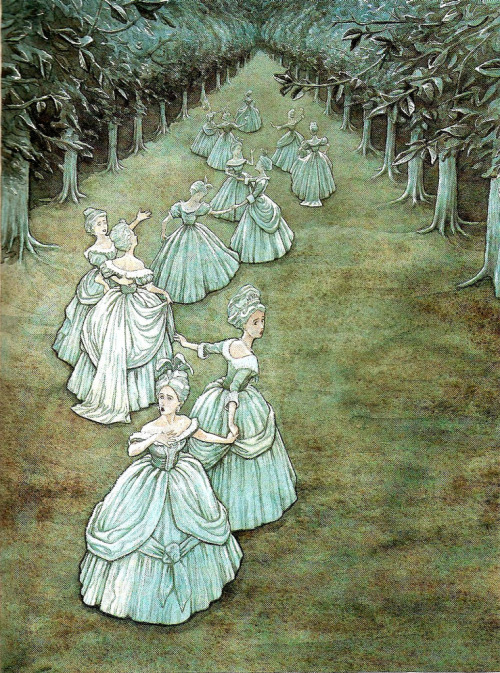
Image Credit
The Twelve Dancing Princesses is a story that I always thought should be more magical than it actually is.  The story begins with something of a mysterious and enchanting scenario:
There was a king who had twelve beautiful daughters. They slept in twelve beds all in one room and when they went to bed, the doors were shut and locked up. However, every morning their shoes were found to be quite worn through as if they had been danced in all night. Nobody could find out how it happened, or where the princesses had been. 
At this point I can imagine all sorts of mythical and frightening plots which cause the girls to be spirited away and hypnotized into an endless dusk to dawn dance.  The king is equally puzzled about the circumstances and places a challenge - anyone who can solve the mystery of where the princesses go will receive permission to marry one of them and become king.  However, anyone who accepts that challenge and does not succeed in three nights will be executed. 

Predictably, "a king's son" is the first to attempt the task and he fails.  "Several others" - whom the reader can assume are also noblemen of some type - follow suit with equally tragic outcomes.  Then comes a different sort of man to attempt the task.  He is described as an old soldier and on his trek into the kingdom and into the story his first encounter is with an old woman who asks his destination.  He replies,
'I hardly know where I am going, or what I had better do,' said the soldier; 'but I think I would like to find out where it is that the princesses dance, and then in time I might be a king.'
I like that the soldier is so unassuming and I think it's this rather ho-hum attitude that sets him up well as the hero of the tale.  Fortuitously, the old woman knows something of the antics of the princesses and warns the soldier not to drink any wine he is offered and gives him an invisibility cloak to help him on his quest.   As is typical with fairy godmother types, this encounter is the only appearance of the old woman in the story.  The reader is never told if she is a seer, fairy, or witch and the fact that she knows so much of what is going on remains unexplained. 
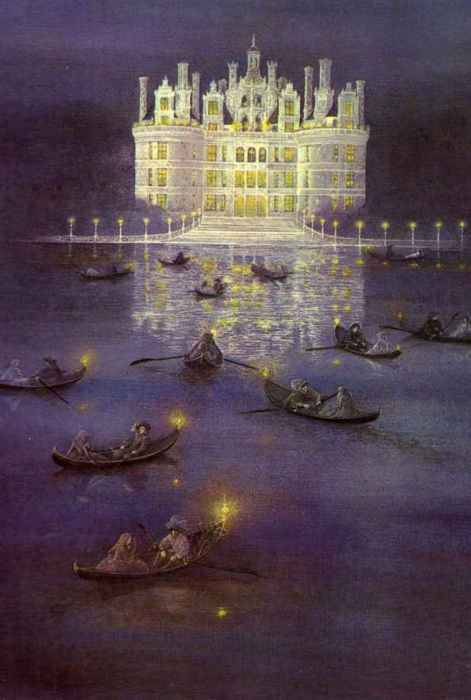
Image Credit
The soldier proceeds to the castle and undertakes the challenge of solving the dancing princess mystery.  Following the crone's advice he drinks no wine, pretends to be asleep, and then dons the invisibility cloak to follow the girls through a trap door in their room.  The princesses proceed down a stairway, into boats manned by twelve princes, to a secret ball where the dance the night away.  The soldier follows and partakes in their revelry with only the youngest princess suspicious of his presence.  The elder girls all tell the youngest that she is imagining things or explain away the sounds she hears.  Three nights proceed the same way with the soldier secretly following the girls and collecting evidence of their activities.

When the time comes for the report to the king, the soldier explains all that he has seen.  Oddly enough, there is little protest or argument from the girls.
The king called for the princesses, and asked them whether what the soldier said was true and when they saw that they were discovered, and that it was of no use to deny what had happened, they confessed it all. 
I half expect the youngest princess to blurt out some form of "I told you so" to her elder siblings.  Though she seemed the wisest and most astute of the lot, the soldier surprisingly chooses the eldest to be his bride.  The story explains that she is a better match age-wise, but I almost wonder if this is to be interpreted as some sort of punishment for the eldest. I found the ending of the story to be rather anticlimactic and combined with the lack of magic and mystery surrounding the princess's disappearance every night, it's not one of my favorite fairy tales.  I know there are several retellings and reinventions of this tale and I would be intrigued to search out and read some of them.  For myself, I would love a new version of the story (though not one starring Barbie) in which the princes that spirit the girls away are wizards or ghosts or possess some other enchantment over the princesses such that their evening dancing is more the result of fantasy than just rebellion.

What do you think of The Twelve Dancing Princesses?  Do you like the ending of the story or do you wish it had a bit more excitement?  Have you read or seen any other versions of this story?  

This post marks my first Fairy Tale Fridays entry of 2012.  To check out more FTF posts and my 2011 Fairy Tale Challenge click here!

Rumpelstiltskin (Fairy Tale Fridays)

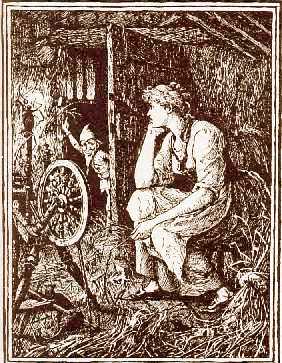
In lamenting a particularly frustrating portion of my work as a research scientist, I once described a group of my assignments as "The Rumpelstiltskin Effect".  I felt as though in moving my project forward I was being asked to spin straw into gold - a task that was in every way something that nobody could do, but still I was pursuing it.  Needless to say, that project did not pan out as well as some of my others.

Reflecting on that portion of my work, I also realized that I've never reviewed and analyzed the popular Brothers Grimm story Rumpelstiltskin.  As many know the story begins with the Sisyphean task for the miller's daughter all because of something her father says:
"Once there was a miller who was poor, but who had a beautiful daughter. Now it happened that he had to go and speak to the king, and in order to make himself appear important he said to him, 'I have a daughter who can spin straw into gold.'" 
Notice that the problems all begin because the man was trying to "appear important".  The adage of pride before the fall comes to mind here as the story is set in motion.  The greedy king locks the girl up with a room full of straw and a spinning wheel and threatens to kill her if she cannot perform the feat by morning.  Partly I wonder if this was the king simply trying to call the man's bluff.  I have to wonder if the king would really go through with executing a subject - and a beautiful one at that - for what seems to be an obvious exaggeration.  So the miller's daughter is more than a little bit stuck.  The story tells us:
"She had no idea how straw could be spun into gold, and she grew more and more frightened, until at last she began to weep.  But all at once the door opened, and in came a little man..."
I'll try not to roll my eyes at why the miller's daughter didn't at least start trying to spin her straw, plead hay fever and demand release, or fess up to her father's lies; but as in many fairy tales, we have a male who comes to her rescue.  The stranger creates the gold in exchange for a necklace and when the king's greed causes a repeat of events the miller's daughter turns over a gold ring.  (Does anyone ever stop to wonder why, if the miller was so poor, does his daughter have a necklace and a ring that become some pretty hefty bargaining chips?  Or why, if Rumpelstiltskin can spin stray into gold, does he have need of the girl's trinkets?  Sorry, moving on.)  On the third night, the girl is once more thrust into a room of straw and told by the king, "You must spin this, too, in the course of this night, but if you succeed, you shall be my wife."

Rumpelstiltskin appears to save her once more but she is left without anything to offer him in trade for his service - and yet he offers her a deal:
"'Then promise me, if you should become queen, to give me your first child.'"
Who knows whether that will ever happen, thought the miller's daughter, and, not knowing how else to help herself in this strait, she promised the manikin what he wanted, and for that he once more spun the straw into gold."
I know fairy tale heroines are not known for their brains but since the king promised to marry her for one more night of spinning and if Rumpelstiltskin had already delivered a straw to gold transmogrification twice, why didn't she think she would be queen?  So the story proceeds with the girl marrying the king, and eventually having a child that Rumpelstiltskin comes to claim.  She pleads with him not to take the baby and he offers her a reprieve if she can guess his name.  (I have to wonder, how did he help her out three nights in a row and she never asked who he was?)  Of course the big "R" is not a name on anyone's lips so the new queen's situation is rather dire.  She sends out messengers to seek new names from all the kingdoms and eventually one returns with the following tale of what he observed:
"Round about the fire quite a ridiculous little man was jumping, he hopped upon one leg, and shouted -
     'To-day I bake, to-morrow brew,
     the next I'll have the young queen's child.
     Ha, glad am I that no one knew
     that Rumpelstiltskin I am styled.'" 
The queen reveals the answer to the guessing game and the peeved little man suffers a rather disastrous fate:
"...in his anger he plunged his right foot so deep into the earth that his whole leg went in, and then in rage he pulled at his left leg so hard with both hands that he tore himself in two."
Typically Grimm, that line is the morbid end to the story.  At first, my reaction to this story is one of disdain.  None of the characters are exceptionally virtuous, but on second look there are some actual morals to be found.  The first may be that honesty is the best policy and that one should not tell lies to make themselves seem more important, but I think the larger lesson revealed is to guard one's words.

There are multiple Biblical proverbs about this topic, and regardless of your thoughts on the divinity of scripture, the advice is exceptionally wise.  One example is Proverbs 13:3 "He who guards his lips guards his life, but he who speaks rashly will come to ruin." (18:21 says, "The tongue has the power of life and death" and 21:23 states, "He who guards his mouth and his tongue keeps himself from calamity.")  Knowing that the Grimms were in the practice of moralizing, I think it can be rather obvious how these verses tie into the tale.

Firstly, the father's boastfulness is what begins the whole fiasco.  The king's harsh threats cause the miller's daughter her panic, which in turn leads to her making an unwise promise to Rumpelstiltskin.  All through the story we see the characters causing their own trouble because of what they say and ultimately, it is the little man's words when he thinks no one can hear him that leads the queen to have his name. 


What are your thoughts on the morals and lessons of Rumpelstiltskin?  Is discretionary speech a good theme to pull out of this tale or do you interpret it differently?  Do you feel bad that things ended so poorly for the titular character or do you think he got what he deserved? 


This post marks another entry in my 2011 Fairy Tale Challenge (10 out of 12) hosted by Tif of Tif Talks Books.  I'd love for you to share your thoughts on this post or any of my previous Fairy Tale Fridays selections and wish me luck in finding two more tales to post about before year's end!

Fables: The Deluxe Edition Book One (Fairy Tale Fridays)

I'm falling woefully behind on my 2011 Fairy Tale Challenge and feeling uninspired by classic fairy tales last week, I sent out a Twitter request to Tif from Tif Talks Books asking her to recommend a tale for me to read and review.  I was expecting something along the lines of HCA or the brothers Grimm, but Tif surprised me by suggesting Fables the graphic novel series by Bill Willingham.  Even more surprising was walking into my local library and spotting book one of the hardbound deluxe edition of the series hours after it was mentioned to me!

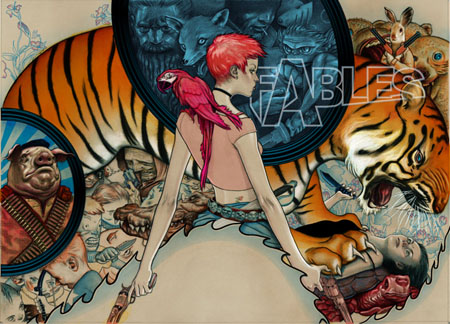
Fables: The Deluxe Edition Book One encompasses the first ten issues of the series.  The first five compose the story "Legends in Exile" (Chapter 1: Old Tales Revisited; Chapter 2: The (Un)Usual Suspects; Chapter 3: Blood Tells; Chapter 4: Remembrance Day; and Chapter 5: The Famous Parlor Room Scene (Sans Parlor).)  In this sequence, the characters and world are introduced and the reader discovers a neighborhood of New York City known as Fabletown in which all the classic fairy tale characters are alive and thriving in modern society without the general population having any clue to their existence.  As the introduction by Bill Willingham states, "Welcome to the woods: where all fairy tales take place - even those that don't."  Ruled over by King Cole and his second in command the ever beautiful Snow White (who has a less than amicable relationship with her ex-husband who is not-so Charming), things are far from happily ever after as the main plot of this section of the story involves a murder mystery and the subsequent investigations by Sheriff Bigby Wolf.

The story was bound to hook me in, but as with any graphic novel, the artwork is what kept me glued to the pages.  I love hardbound editions to graphic novels because not only do I love diving into multiple issues at at time but I love that the finishing on the inking and design gives them an even more vibrant look.  Color aside though, I think this is a series that would be enjoyable in any format since I really just loved the way the characters were conceived and drawn.  Take this example of a figurine designed off sketches from issue eight:


Which brings me to the second half of The Deluxe Edition, the story "Animal Farm" (Chapter 1: Road Trip; Chapter 2: The Guns of Fabletown; Chapter 3: The Pirates of Upstate New York; Chapter 4: Warlord of the Flies; and Chapter 5: Twilight of the Dogs.) 
"Animal Farm" comprised a much darker tale involving the non-human residents of the fairy tale community who, unable to blend into normal city life, have their own residence on a farm in upstate New York.  The title taken from Orwell's classic is no coincidence and the literary allusions don't stop with a revolt led by one of the three pigs.  I was really impressed with the more sinister feel of this set of tales.  Willingham creates a story arc that is constantly surprising and I know if I had read this issue by issue I would have been agonizing over each and every cliffhanger.  

All in all, I'm really glad to have discovered Fables.  I'm thankful both for Tif's suggestion that brought it to my attention and for the fact that my local library carries graphic novels.  I know some readers consider "comic books" to be some substandard form of literature, but I can honestly say that the storytelling I found in this series was as complex and intriguing as many of my favorite fantasy works and I find that well done artwork enhances rather than detracts from the narrative.  (This picture is the spread cover of the Deluxe Edition - just had to give another example of the creative and imaginative artwork found in the collection!)


Fables: The Deluxe Edition Book One by Bill Willingham is the latest entry in my 2011 Fairy Tale Challenge (9 out of 12).  Are you familiar with the Fables series?  Is it one you're interested in checking out?  What are your thoughts on graphic novels as literature?  Does your local library carry them?

Tyger, Tyger (Series in September)

Book: Tyger, Tyger by Kersten Hamilton

Series: The Goblin Wars

Book Order: Tyger, Tyger* (1); In the Forests of the Night (2) - coming November 2011
* indicates a book I have read

Teagan Wylltson, also known as Tea, is a more or less average teenager with an artistic mother, a bookish father and a younger brother Aiden who has a gift for karaoke.  She has a great internship working with primates at the local zoo and is on track for a college scholarship, yet things start to get strange when Finn Mac Cumhaill arrives.  Introduced as a not-quite-cousin, Tea and her best friend Abby are pretty sure that Finn is trouble despite Tea's attraction to him.  Finn leaves almost as soon as he arrives, but when malevolent shadows strike out at Tea's family, she soon discovers that the Irish stories and legends her parents used to read to her are more than just myths and fantasy. She learns that Fear Doirich - the goblin king - is frighteningly real, and when he spirits away Tea's father it's up to her, Aiden, and Finn to mount a rescue.  Delving into a land that she barely understands, Tea must learn the truth about the stories she thought she knew, including the secrets about her own identity and the normal life she's always known.

Kersten Hamilton weaves an enchanting young adult urban fantasy story in this book.  I loved that it was set in Chicago with ties to Irish myths and legends.  Teagan was an exciting and dynamic heroine who displayed honest emotions - fear, concern, uncertainty, regret - while still possessing a bold spirit to face the challenges in front of her.  Finn was intriguing, a good conflicted hero, and I hope there is a bit more development of his character in the second book.  The supporting cast was also delightful and musically-minded Aiden and Teagan's friend Abby - who may have ties to the mafia - added a spark of humor to the novel.  Filled with action and imagination, the book was well paced.  At times chilling, funny, sentimental, and surprising Tyger, Tyger was a great blend of modern storytelling with Irish mythology.  Continuing on with William Blake's influence for a title, the second Goblin Wars book In the Forests of the Night (due to be released in November of 2011) promises to carry on the beautiful setup of this novel and hopefully deliver more of the same.  

Along with featuring this book for Series in September, I want to include it as part of my 2011 Fairy Tale Challenge (8 out of 12).  The incorporation of traditional characters from Irish legends make this a great work for those that love updated versions of classic stories.  I was originally attempting to blog one fairy tale a month, so I'm a little behind on my schedule, but I hope to still make 12 by year end.  I'll happily take recommendations for tales I should read, too!  And if you want more information about the genesis of the 2011 Fairy Tale Challenge check out the blog that started it and got me hooked on fairy tales once again: Tif Talks Books!

Author Interview - Kate Ellison (Fairy Tale Fridays) (Indie In Summer)

As mentioned in my previous post, Fairy Tale Fridays and Indie in Summer have merged together this week with my review of The Curse Girl and today's interview of the book's lovely author!  Please join me in welcoming Kate Ellison!

Kate Ellison's "Portrait of a Writer"
*applause, applause*

Hi Kate! Tell us a little bit about yourself. How did you get started as a writer?

I've always been addicted to telling stories, even before I knew how to read and write. I wrote fan fiction mostly as a teenager, and I dabbled in terrible poetry. When I was in college, I decided I would write a novel and get it published, but I knew almost nothing about how to do that, and I got discouraged and quit after a few months. After several years of no writing and a lot of creative stewing, I was inspired by some things I'd read, and I started writing again in earnest. I wrote a few books and began submitting short stories to various markets to build up some publishing credits. Then I read about the changes in self-publishing and the rise of the indie author, and I decided to give that a try. Now I have one novel out and more on the way. It's been an exciting journey and I'm absolutely thrilled to be where I am now.

Your book The Curse Girl is a modern adaptation of "Beauty and the Beast", do you have a favorite version (besides The Curse Girl) of the story?

Hmmm. It's hard to say--I think maybe Robin McKinley's Rose Daughter. But I also always loved the Disney version too.

Was it difficult to choose how much or how little to vary your story from the source material?

With a retelling, I like to use the original tale as a jumping off point and then see where the story takes me as it unfolds. When you set up certain constraints from the beginning, they shape the way the story plays out, but beyond that I wasn't devoted to a strict adherence to the source material. I did, however, want to preserve some of the original themes, and I think I did that.

Have you always been a fan of fairy tales? Besides "Beauty and the Beast", which one(s) is/are your favorite(s)?

I have always adored fairy tales. When I was a little girl, I had 3 or 4 big collections of them that I read them over and over. I liked seeing how different versions told the stories differently.

My favorite fairy tale might be Cinderella, not really for the story itself, but for all the lovely retellings it has inspired (Ella Enchanted is my favorite, followed by Ever After. Plus I have a Cinderella retelling that I'm itching to write!)

The Curse Girl begins at the moment Beauty, also known as Bee, is arriving at the house of "The Beast". Though I wanted to know more about her family and the reason she was there, I loved that you thrust the reader immediately into the story. How did you choose to begin the tale at that scene?

I probably could have started earlier, like the original tale does, but I felt it was unnecessary. I wanted to jump in right to the moment of action--since we all know the story, I felt like I could trim the extras without confusing anybody.

What are your thoughts on "happily ever after" endings - great conclusion or overdone cliche?

I like them. Some of my favorite book endings ever include the epilogue in Robin McKinley's The Blue Sword and the ending of Pride and Prejudice, which are both pretty happy. You don't always get them in real life, and they might seem a little naive to some people, but I enjoy having them in literature. On the other hand, I also love dark, realistic stories that don't quite resolve, like Margaret Atwood's stuff, so I equally appreciate that sort of ending as well. I guess it depends on the story and what fits it.

Zombies vs. Unicorns: Zombiecorns
Your website features some pretty funny stick-figure cartoons, what prompted you to start expressing yourself with these drawings?

Well, probably two things. I was raised on a steady diet of Calvin and Hobbes comics (not stick figures, but humorous and definitely an influence on what I find funny) and I always loved Calvin's hilarious expressions. I'm also an avid follower of the blog Hyperbole and a Half, so her style influenced me. Plus I like expressing myself with humor. It's a nice change of pace from writing, and it's a great creative outlet when I'm frustrated with a book that isn't coming together the way I'd like.

What would you say are the biggest challenges and rewards to being an independent author?

The biggest challenge is probably being taken seriously/getting treated badly within the industry. The traditional/self-publishing debate is almost as polarizing as politics. A lot of people are awesome and very supportive of indies, but unfortunately, some writers look down on people who self-pub and either 1) dismiss their work as terrible or 2) dismiss the authors themselves as simply impatient hacks who were unable to get a traditional deal (although this mindset is thankfully changing). I hadn't expected to encounter this attitude and I was speechless the first time I did. It was a HUGE eye-opener for me. I never tried to get The Curse Girl published traditionally because I really wanted to try being an indie author. I wanted to do it out because it sounded awesome, not because I was impatient or incapable of doing anything else. These attitudes aren't fun to encounter, but I think the solution is to continue to behave professionally and treat other writers with support and graciousness no matter what path to publication they choose.

The biggest reward of independent authorship is total creative freedom. I love designing my covers, I love choosing my release date, and I love writing my own book blurbs. These are the reasons I wanted to be an indie! The only thing I don't love is paying for my own advertising (ha!) and doing my own copy editing (hopefully I'll be able to outsource that one soon ...)

What projects are you currently working on?

Several very exciting things are in the works! I have three books I'm working on right now--a dystopian novel about a group of people living underground who have never seen the sun, a fantasy about a human and a fairy who fall in love, and a paranormal monster story that takes place in wintery Maine. I also have a zombie book that keeps getting put on the back burner.

Where can we find out more about you and your work?

You can find out more about me by visiting my blog: http://thesouthernscrawl.blogspot.com/ or following me on Twitter: @KEllisonWrites I love meeting new people!

Thanks for joining me Kate!

The Curse Girl (Fairy Tale Fridays)(Indie In Summer)

I know it's not quite Friday but consider this a double dose of Fairy Tale Fun with a book review today and an author interview tomorrow!

Taking a modern spin on the classic tale of "Beauty and the Beast", Kate Ellison's The Curse Girl begins with teenage Beauty, also known as Bee, arriving at the doorstep of a strange old house known to be the home of the village Beast. Dropped off by her father as something of a sacrificial lamb to save his family, Bee bravely enters the house where a world of magic awaits her.

The labyrinthine mansion with its self-lighting candles and ever-changing rooms and corridors is but one of many wonders Bee encounters as the structure's denizens are even more unique. She meets Butler and Housekeeper who are as integrated into the house as their names suggest and the little girl Rose, who becomes more plant-like every day. And then there is the Beast. Rather than some bizarre monster, Bee encounters the head of the household as a young man named Will. A large scar mars his countenance but the most beastly thing about him is in fact his short temper. Bee, however, has a fiery personality to match Will's own, and she soon discovers that it's up to her to break the riddle-filled curse that holds them all enslaved if she ever wants a chance to go home.

I enjoyed the fantasy elements that Kate Ellison blended into this story. The characters are intriguing and the puzzles involved in the curse were unique. I didn't find Bee particularly easy to relate to - the book would probably be better suited to a younger audience - but I still appreciated her spirited nature. I also enjoyed the relationship between Bee and Will, which developed throughout the story.

With a sprinkling of fairies, witches, and shapeshifters, this urban fantasy work manages to update "Beauty and the Beast" for today's teen readers, while still maintaining the elements of the story that make it so beloved. All in all, The Curse Girl is a creative new take on a classic story.

This work also marks an odd hybrid between my Indie In Summer feature and my 2011 Fairy Tale Challenge (7 out of 12).  Stay tuned tomorrow for my interview with author Kate Ellison as we discuss her work and favorite fairy tales!

Rapunzel (Fairy Tale Fridays)


"Rapunzel, Rapunzel,
Let down your hair!"

Those words may be the most iconic and memorable portion of the story of Rapunzel, but the phrase, though oft repeated, is just a small portion of the original fairy tale.  Since my last entry for Fairy Tale Fridays featured Melisande, an updated long-hair princess story, I thought I would take this week to explore the classic version of Rapunzel.  As is often the case, the story has origins dating to the 1600's but the version that most consider the classic tale is the one recorded by The Brothers Grimm. (Full text of the story is available here.)

In this version, a childless couple lives next to a walled garden owned by a witch.  Seeking to please his wife, the man sneaks into the garden to steal some rampion.  Though successful at first, the man's thievery is discovered by the witch who demands, as payment, "the child [his] wife will shortly bring into the world".  It is unclear in the story whether the wife was expecting before the man went to steal the rampion.  I used to assume the the wife's craving was associated with pregnancy, but an interesting alternative was that the wife was simply looking for things denied to her as part of the frustration of her inability to have children.  With this perspective, it could also be taken to mean that the man's interaction with the witch caused his wife to conceive.  It could be that the only reason the man agreed to the witch's deal was that he did not believe his wife would ever have a child.  Needless to say, the man strikes the bargain, a child is born, and the girl is given over to the witch who promises to care for her as a mother.  (Rampion is a plant similar to lettuce or spinach and is also called rapunzel, giving the girl and the story its name.) 

Rapunzel, of course, is kept in a door-less tower by the witch who comes to see her and climbs into her window by requesting each time the well-known phrase, "Rapunzel, Rapunzel, let down your golden hair!"  In the Grimm story, her hair is golden and it's one of few details preserved from the original story in the Disney film Tangled.  (Loved the film, but for now I'm going to tailor this post towards the original story.)  The witch's method of entry into Rapunzel's tower is then observed by a prince who hears Rapunzel's singing and falls in love with her.  She is frightened by him at first but he wins her over with kind words and compliments.  He pleads for her to escape with him and she instructs him to "bring a skein of silk" every time he comes to see her and plans to construct a ladder to use to climb out of the tower.

This is definitely the portion of the story where the reader could conceive of better plans than the protagonists.  One wonders why the witch would not be suspicious of skeins of silk accumulating in the tower room.  And of all the materials to ask for, why silk for a ladder when hemp rope, linen, or even cotton would be a much better material to work with.  Granted, Rapunzel also could have cut off her own hair and climbed down the tower herself.  I don't know the reason for Rapunzel's instructions, but I like to imagine that she is testing her prince.  Silk would be expensive and rare so she was measuring how much her freedom was worth to the prince, and by instructing him to come every day she was testing his devotion to her.  Rather than just run off with him, he needed to prove himself worthy of her first.

Of course, before the prince's love and determination are witnessed, Rapunzel makes a big blunder.  She reveals her relationship with the prince to the witch.  The witch cuts off Rapunzel's hair and casts her into exile.  Waiting in the tower for the prince, the witch fools him with the hair into climbing the tower before revealing that Rapunzel is gone.  And then the prince throws himself out the window.  I'm not sure why he was so easily upset by the witch.  I would have preferred for him to fight for Rapunzel or demand to know her whereabouts.  I can only assume - or at least hope - that there was some magic involved in the prince's instant turn toward despair.  Though he survives the fall from the tower, he is blinded by thorns which prick out his eyes.

One might expect a Brothers Grimm story to end here.  Rapunzel is cast out, the prince is blind, and the witch is seemingly triumphant.  However, there is something better in store for the ending of this tale.  The prince wanders far and wide, until,

"...he came to the desert place where Rapunzel was living. Of a sudden he heard a voice which seemed strangely familiar to him. He walked eagerly in the direction of the sound, and when he was quite close, Rapunzel recognized him and fell on his neck and wept. But two of her tears touched his eyes, and in a moment they became quite clear again, and he saw as well as he had ever done. Then he led her to his kingdom, where they were received and welcomed with great joy, and they lived happily ever after."
I love that this one ends with the classical last three words.   As much as I enjoy when tales take darker turns, I always appreciate it when things finish on a positive note. 

This post is part of my 2011 Fairy Tale Challenge (6 out of 12) inspired by Tif of Tif Talks Books.  What do you think about the original version of Rapunzel?  Feel free to share your thoughts in the comments section here or link up with your own post about this tale or any fairy tale you feel like reading this month!

Melisande (Fairy Tale Fridays)

I realize that I'm catching the tail-end of this one (May 2-8), but I didn't want the week to pass completely without taking the time to focus on a great book that's a fun read for kids of all ages.

Melisande by E. Nesbit is a great fairy tale story including a princess, a host of fairies, magic wishes, and several other classic bedtime story elements.  However, this is also a story that takes a few twists from the predicted path and plays upon traditional fairy tale cliches. The whole story is available here, but the illustrated version is an even more delightful read. 

Melisande is a princess born to a rather wise king and a very typical queen.  In discussing their daughter's christening party, the royal couple decides not to have a celebration since whenever a fairy is not invited - and one among the many is inevitably always forgotten  - that fairy places a curse on the child.  The parents' decision rather than pleasing the fae of the kingdom serves to anger them all.  Luckily, Melisande survives with only a single curse placed upon here - she is bald.  The young child grows up to be exceedingly kind and lovely and has very little regret of missing locks, but as she ages her mother decides she should have hair.

Using an overdue wish from her father's fairy godmother, Melisande wishes for hair and on her mother's urging gains a golden yard which grows an inch every day and grows twice as fast every time it is cut.  The wise king is the only one who initially sees folly in this wish as, "he had a mathematical mind, and could do the sums about the grains of wheat on the chessboard, and the nails in the horse's shoes, in his Royal head without any trouble at all."  And Melisande's ever growing hair becomes not just a source of amusement in the tale, but a great lesson in numbers for young learners as well!

As the gift becomes quite unmanageable, princes are summoned to the kingdom to solve the hairy dilemma (couldn't resist!), one comes up with the solution to not cut the hair off the princess but to cut the princess off the hair!  What seems an ingenious answer soon proves equally problematic, and once again it is the king who sees why.

"Humph!" said the King, who had a logical mind. And during breakfast he more than once looked anxiously at his daughter. When they got up from breakfast the Princess rose with the rest, but she rose and rose and rose, till it seemed as though there would never be an end of it. The Princess was nine feet high.
"I feared as much," said the King, sadly. "I wonder what will be the rate of progression. You see," he said to poor Florizel, "when we cut the hair off, it grows — when we cut the Princess off, she grows. I wish you had happened to think of that!"
I won't give away the ending of the story (and only said as much as I did because of the cover image with a rather giant princess) but it really is a clever and charming tale.  For young fans of the recent Disney hit movie Tangled, Melisande is a great story with a similar long-hair problem as Rapunzel and with humorous twists and turns to be encountered as it is solved.

Along with celebrating the joy of young readers during Children's Book Week, this story is also part of my 2011 Fairy Tale Challenge (5 of 12) begun by Tif at Tif Talks Books.  Feel free to share your thoughts about Melisande in the comments section or link up with your own post featuring your favorite Children's Book or Fairy Tale!

Juan Bobo's Pig - La Puerca de Juan Bobo (Fairy Tale Fridays)

Happy April Fool's Day!  For those unfamiliar with the "holiday" or at least the American take on it, April 1st is referred to as April Fool's Day and is generally considered a day for people to play lighthearted jokes or pranks on others.  Though some people will use the day for malicious endeavors, I've always enjoyed it as a time for silliness and make it a point to try to fool people - if even for a brief moment.  Sometimes it can be something as silly as declaring, "It's snowing outside!" to see how many recently risen sleepyheads will rush to the window in search of late winter flurries.  Other times I've pretended to lose something important - "I lost my keys!" in a panicked voice before pulling them out of my purse.  My family has always found laughs in funny little "Gotcha!" moments and I will even admit that it's just as fun when the joke is on me!

But the name "April Fool's Day" also got me thinking about the word "fool" as a noun rather than a verb, and I've been reflecting on how often the character of a fool comes up in fairy tales.  The first one that comes to my mind is Jack of Jack and the Beanstalk fame.  The young boy who sells his cow for magic beans is an obvious answer of a gullible character despite the fact that the beans he buys truly are magic.    There are also plenty of examples of fairy tale heroes and heroines playing the trickster and the fool is their rival in the story.  Examples of this are the Anansi stories of folk lore and Uncle Remus' Brer Rabbit tales (many of which were inspired by the spider god).

The story I want to bring up this week though is one that I encountered for the first time in high school.  As a teenager, I probably considered myself too old for fairy tales, but as I was learning Spanish, one of my instructors frequently gave us folk tales from Latin America to read - often featuring a character named Juan Bobo.  (I know folk tales and fairy tales aren't quite the same thing, but I guess this could be considered me fooling all of those who thought this would be a true fairy tale post.)  The name Juan Bobo roughly translates to Dumb John and the stories of his adventures are mostly silly tales with shenanigans involving misinterpreted instructions.  At first I thought this concept was somewhat unjust in making fun of someone with a mental disability, but culturally, these stories are not intended to poke fun at those with actual mental problems, rather just run-of-the-mill lack of common sense.   An apt comparison would be the practice of telling "blond jokes" - few people believe that individuals with blond hair are less intelligent that others, the group just serves as a target for the joke telling platform. 

I had a difficult time finding an online version of any of the Juan Bobo stories (especially translated to English) but one I was able to find - that I remember reading in high school - is La Puerca de Juan Bobo, or Juan Bobo's Pig.  In this story, Juan Bobo is told by his mother to wash their pig before selling it in the market.  The mother instructs him to make the pig "look as beautiful as [he] can."  To most people this would just involve washing the mud off the animal, but to Juan Bobo it goes much further.

"Juan Bobo went to his mother's closet and got out her red taffeta skirt with the elastic waist band, and he slipped that around the pig's waist...He borrowed a blouse and a bright red wig, and he fit those onto the pig.  He outlined the pig's eyes as best he could with black eyeliner and a touch of blue eyeshadow; he put bright red lipstick on the pig's lips; and he got two pairs of his mother's high-heeled pumps and strapped those onto her trotters.

"Now the pig looked really beautiful to Juan Bobo!"
Of course, Juan Bobo runs into trouble on the way to the market when the pig decides it would much rather wear mud than makeup and heels.  There's not much of a moral to the story outside of the fact that animals will follow their instincts and it is futile to try to make them what they are not; but the true purpose of this and most of the Juan Bobo stories are laughter and silliness.  It is the image of a pig dressed up in fancy clothes, a wig, and high heels that gives the tale entertainment value and the phrase "como la puerca de Juan Bobo" (like Juan Bobo's pig) is still used to describe someone who overdoes makeup and accessories to a ridiculous degree.  (As far as I'm aware, though this is an insult, it's not a vulgar one.)

So what do you think about fool's in fairy tales and folk lore?  Do you have a favorite story of a trickster or foolish hero?


This story is part of my 2011 Fairy Tale Challenge (4 of 12) which began as Fairy Tale Fridays originally hosted by Tif of Tif Talks Books.  Feel free to share your thoughts on Juan Bobo's Pig in the comments below or leave a link to your own Fairy Tale Friday post and let me know what tale you're talking about this week!  I'm also eager for suggestions so if you have a favorite story (classic or retold) to share I'm always on the lookout for stories that are new to me!

The Emperor's New Clothes (Fairy Tale Fridays)

For this week's edition of Fairy Tale Fridays, I wanted to revisit a classic story that I remembered and loved from my childhood.   The Emperor's New Suit (or "The Emperor's New Clothes" as it is often called) by Hans Christian Andersen relates a fable about a vain ruler whose "only ambition was to be always well dressed."  This seems a very selfish goal for someone in such a high position but it is this attribute that leads to his troubles and ultimately to the grand lessons of the tale.  As the story begins, 

"...two swindlers came to this city; they made people believe that they were weavers, and declared they could manufacture the finest cloth to be imagined. Their colours and patterns, they said, were not only exceptionally beautiful, but the clothes made of their material possessed the wonderful quality of being invisible to any man who was unfit for his office or unpardonably stupid."

I love that the story takes place in a fairy tale like realm where the general populace would possess enough superstition and naivete to accept the existence of such magical fibers.  And of course none of them - at first - have the humility or courage to admit that the cloth is invisible to them or to challenge the so-called weavers' claim.  As the swindlers work, the emperor sends many people to inspect their progress.  Both a minister and a courtier that the emperor deems honest go to see the fabric.

Neither wants to admit to being unfit for their position or to be declared "unpardonably stupid" (love that phrase), so both of them lie and report to their leader that the cloth is beautiful, the design and colours exquisite.  At this point in the story, I always wonder what would happen had the emperor sought to see for himself rather than sending others in his stead.  The emissaries he sends to report for him are both described in the tale as "honest" and yet neither is truthful to the emperor.  Here we see one of many important lessons coming out of the tale and it's not only that honesty is the best policy but it's caution in whom we trust.  In a quote usually attributed to Shakespeare, Sir Walter Scott wrote,
"Oh what a tangled web we weave,
when first we practice to deceive."
I can't think of a more appropriate way to summarize what happens in this story.  All of the townspeople and everyone close to the emperor begins to fabricate (pun intentional) what the cloth looks like and when the emperor is finally presented with the work, he goes along with the charade.  Often in telling this story, blame of some sort is placed on the emperor but I like to cut him some slack.  In many ways he's the last person to pretend to see the fabric and in his situation, with everyone around him declaring to see the material, it would be immensely difficult to admit to not seeing it.  However, since all we ever learn about him is that he is the ruler and enjoys fine clothing, I often wonder why he did not just pretend to disagree with the weavers' taste.  Why did he not throw out the "suit" and declare it ugly?  Or, when pretending to try it on, why not argue the fit as uncomfortable and refuse to be presented in it?

Yes, it was foolish of the courtiers and the people to pretend to see what they did not, but in the end, the emperor was the only one who went so far as to don the imagined clothing!  The ending of the story is rather amusing as a young child finally declares - as the emperor is paraded through the streets - "But he has nothing on at all".  This is both a testament to childlike innocence as well as an observation of mob mentality.  Once the statement is made it ripples through the crowd until reaching the ears of the ruler.  Andersen closes the tale with the statement, "That [hearing the crowd] made a deep impression upon the emperor, for it seemed to him that they were right; but he thought to himself, 'Now I must bear up to the end.'"  So despite knowing the truth, he goes on with the pretense in order to once again save face, providing Andersen a final satirical barb.

This story is a wealth of morals and lessons and I really enjoyed rereading it.  I was surprised at how close the text was to the various versions I heard and read as a child.  It wasn't a twisted or darker version of what I remember and still maintains a lighthearted humor and silliness for bedtime enjoyment.

The Emperor's New Suit by Hans Christian Andersen marks 3/12 in my 2011 Fairy Tale Challenge and continues Fairy Tale Fridays originally started by Tif of Tif Talks Books!  Feel free to share your thoughts on  this tale in the comments below or join in the fun with a post of your own!  I'd love to hear about what fairy tales - new, old, reinvented, retold - you're reading this week as well!

The Phoenix Bird (Fairy Tale Fridays)

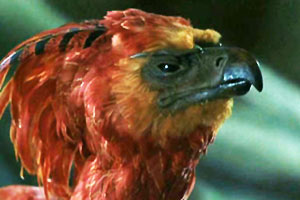
One of the reasons I love fantasy as a genre is for the mythical creatures.  Unicorns, griffins, minotaurs - I love the imagination of new beasts and monsters and one of my favorites is the Phoenix.  I knew the legend of the bird that dies by immolation and is reborn from its own ashes and of course, I loved how J. K. Rowling used Fawkes the Phoenix as a hero and symbol of hope in the Harry Potter series (most notably in book/movie two: Harry Potter and the Chamber of Secrets).

But I was intrigued when I discovered that Hans Christian Andersen had his own story about and titled after The Phoenix Bird (click the link to read the story).  It's a short tale - more akin to the origin type story told in The Ear of Corn by the Brothers Grimm than the usual fairy tale style I've come to associate with Andersen - but I do like it.  If you're not familiar with it, take the time to read it before continuing with this post because my favorite part really is the ending. 

There are a few things that speak to me about this story.  If we take the Phoenix as a symbol for the spirit of creativity and imagination, we see that it has been around since the dawn of creation.  As long as there have been human beings, this spirit has lived among them.  Andersen writes, "The bird flutters round us, swift as light, beauteous in color, charming in song," and one can imagine the natural gift of creativity in the form of a mythical bird swooping through Andersen's pen as this tale was composed.  We can also see that the Phoenix is shown to be universal - belonging to no single land or culture - and with the varied lands described in the story it is clear that the Phoenix "is not the bird of Arabia alone." Andersen ends the story with a lovely tribute to the bird in proclaiming a name for it:
"...thy right name was given thee—thy name, Poetry."
I think this is a fitting conclusion to the simple story because in its essence this piece is much more of a poem than a traditional  tale.  The short length of the work and the vibrant writing speak much more of poetry than of a typical fairy story with a happily ever after ending.  What do you think about Hans Christian Andersen's The Phoenix Bird

This post is part of my 2011 Fairy Tale Challenge (2 of 12) and continues the Fairy Tale Fridays meme originally begun by Tif of Tif Talks Books.  I'd love to hear your thoughts on this story or any other fairy tale of your choice!  Leave a link in the comments below if you're joining the Fairy Tale Fun this week!

Princess Academy (Fairy Tale Fridays)

 In the past I've used Fairy Tale Fridays as a chance to explore classic fairy tales such as those by Hans Christian Andersen and The Brothers Grimm.  However, I also want to use this meme and my 2011 Fairy Tale Challenge to focus on some modern books that very easily fit into the fairy tale genre.  Today's pick is from an author that composes fiction for readers of all ages.  I previously read and reviewed her novel The Actor and The Housewife, but today I want to spotlight a different book by Shannon Hale.

Princess Academy is a cute fairy-tale story perfect for youth or young adults but easily enjoyed as a light novel for grown readers too. The book tells the story of Miri, a young girl from a mountain village who feels useless to her town since she is forbidden to work in the rock quarry with her family. One day an emissary from the king comes to the mountain and reveals that the king's priests have determined that the prince's bride is to be chosen among the girls from Miri's village.

Miri and all her friends are sent to a special Princess Academy to learn the ways of royalty but as Miri progresses through the school she finds that, even more than becoming a Princess, what she really longs for is a place to belong. With themes of the importance and potential of all people, and with a story that is sweet and yet unpredictable, Shannon Hale's Princess Academy is a charming tale that deserves all the accolades showered upon it.
I don't want to give away too much of this story, but I will say that it's a lovely fairy tale.  For those looking for a recent publication of an ages-old genre, this is definitely a short novel that you won't want to miss!

The 2011 Fairy Tale Challenge (Fairy Tale Fridays)

Last September, I was introduced to a charming blogger named Tif and her delightful blog Tif Talks Books!  Amidst her book reviews and literary conversations, Tif had a meme that I fell in love with called Fairy Tale Fridays!  I joined in for several weeks (my posts can be found with the tag "FTF") but discovered this month that Tif had been blogging Fairy Tales since last January and only planned the meme to last for a year.  Knowing how much I enjoyed the weekly trek into Fairyland and seeing how a few of my Fairy Tale posts remain in my top ten most read posts of all time; I definitely want to continue posting about fairy tales, which is why I am delighted to see Tif present her readers with the 2011 Fairy Tale Challenge!


Now, I'm not normally big on challenges and generally prefer to let whimsy dictate my reading material, but this is blogging goal that I want to place upon myself.  I'm stepping into this challenge full throttle and going for the highest level of Happily Ever After (check out Tif's challenge post for level descriptions) and will aim to post a review or analysis of a fairy tale 12 times from now until December, which should figure to be about once a month!  For convenience sake, I'll still call these posts "Fairy Tale Fridays" - to maintain my already existing "FTF" tag - but technically they are now part of the 2011 Fairy Tale Challenge.  If you have any great tales (classic or modern) to recommend or that you want to hear my thoughts about, feel free to leave me comments and if this challenge sounds like fun to you, hop over to Tif's blog and sign yourself up!

The Snow Man (Fairy Tale Fridays)

Welcome back to Fairy Tale Fridays, a meme hosted by Tif of Tif Talks Books.  This week, with winter - and plenty of snow - upon those in my region of the United States, we're looking at the story The Snow Man by Hans Christian Andersen.

This story is a little strange in that it doesn't have a clear cut theme or moral running through it.  In the most basic sense, it is just a fanciful story about the goings-on of a snow man and the things he does, thinks, and says.  The reader is told very little about the building and the genesis of the snowman's life.  He simply appears fully anthropomorphic at the start of the tale with the line,

"It is so delightfully cold,” said the Snow Man, “that it makes my whole body crackle. This is just the kind of wind to blow life into one."
This seems to set the icy creation up as the hero of the tale but he never quite becomes a protagonist to relate to, as he is more or less confused and bumbling, taking all his cues and information about the world around him from the other main character, the dog.  

In fact, the dog goes so far as to explain to the snowman about the miraculous thing known as the stove.  Peering through a window, the snowman catches sight of the stove and amusingly falls in love with the object.  The reader knows that this romantic infatuation is doomed from the beginning but nevertheless the snowman peers longingly through the window throughout his brief life.

The story ends predictably with our hero melting away.  I wonder if perhaps, Andersen's main point of this tale is the transient nature of life.  We're all born and we all die, but it is what happens between those two events that really defines each one of us.  I could extrapolate on this to say that the snowman had a more interesting and unique life because he decided to love the stove.  Andersen could very well be saying that we all are like the snowman and our brief lives are enriched by the decision to love others.

Or it could just be a fanciful little story based on the question of what would a snowman do and say and think, if in fact a snowman could do and say and think.

What are your thoughts on this wintery fairy tale?  Feel free to comment here or join in with your own Fairy Tale Fridays post and link up over on Tif Talks Books!

Snow White and Rose Red (Fairy Tale Fridays)

Snow White and Rose Red by The Brothers Grimm is the type of story that I think of when I think of fairy tales as bedtime stories.  There are lovable main characters, some mild peril, mythical creatures, magic, a happily ever after ending and some lessons learned along the way.  I vaguely remember this story from my childhood and I think if I had been more familiar with it, it would have been one of my favorites since it centers on a pair of sisters.  I'm from a family of four children and have always been close to my siblings.  I love the way this story opens with the relationship of the sisters,
...two children who were like the two rose-trees, and one was called Snow-white, and the other Rose- red. They were as good and happy, as busy and cheerful as ever two children in the world were, only Snow-white was more quiet and gentle than Rose-red. Rose-red liked better to run about in the meadows and fields seeking flowers and catching butterflies; but Snow-white sat at home with her mother, and helped her with her housework, or read to her when there was nothing to do.
The two children were so fond of one another that they always held each other by the hand when they went out together, and when Snow- white said: ’We will not leave each other,’ Rose-red answered: ’Never so long as we live,’ and their mother would add: ’What one has she must share with the other.’
Granted, my siblings and I were not so polarized, we each had a little Snow White and Rose-Red in us, but I love the friendship and unity between them and I like that right from the start, a moral about sharing is introduced.   As the story proceeds the two girls learn another lesson about fear and not judging things by appearances only.  Their adventure continues and the youngsters find themselves in a situation (a fairy-tale-appropriate three times) to come to the aid of a curmudgeonly dwarf.  Each time they rescue him, he curses their actions and grumbles at them.  This might be my favorite lesson of the tale because the children do good with no reward.  I think it is a poignant moral that helping others is always right, even when we are not thanked or appreciated for what we do.  Also, the ungrateful dwarf gets his own just reward and the generous girls are given a lovely version of happily ever after.

What are your thoughts on the tale of Snow White and Rose Red?  Do you have a favorite moral or theme from this story?  Share your thoughts here or link up with your own post to join the Fairy Tale Fridays Fun!

Fairy Tale Fridays is a weekly meme hosted by Tif of Tif Talks Books!  Check out Tif's post for the upcoming stories in December!  Join in with posts of your own and check out the other blogs involved!

The Ear of Corn (Fairy Tale Fridays)

The Ear of Corn is a story by The Brothers Grimm that is more a fable or a legend than what I usually think of when I hear "fairy tale".  I've lived in the Midwest region of the United States my entire life so I'm no stranger to fields upon fields of corn which often are, as the saying goes, "knee high by the fourth of July".   And yet, I've never given much thought to the origins of corn.  It's something I just take for granted as having always been here.

At the same time, I love stories that involve how things came to be.  As a child I remember loving Just So Stories by Kipling and others in that same style - the ones that had fables of how the camel got his hump or why the elephant has a trunk and the giraffe a long neck.  I think The Ear of Corn story fits in with these types of origin tales.  The story relates how corn used to grow with multiple ears on a single stalk.  Because mankind didn't appreciate the plentiful nature of corn, God removed the crop and only returned it to it's single ear per stalk form after hearing cries from the people.

I really like the quote from this story that says,

"Men however are so made, that when they are too well off they no longer value the blessings which come from God, but grow indifferent and careless."

I think this is an interesting reminder about living life with a spirit of gratitude.  Often times on or around Thanksgiving and Christmas people talk about how blessed they are to have things like family, shelter, food, jobs, clothing, and other things that they otherwise take for granted.  I certainly won't speak out against this notice of life's everyday blessings, but why not make it a point to appreciate them every day, all year long?  Similarly, around the holidays people often take the time to recognize those less fortunate and give more to charity, participate in service projects, and make an effort to feed the hungry, clothe the naked and heal the sick.  Why not take these same steps to help others in January, April, and August?  I think this story makes a good point - that holds true today - about how we recognize blessings most when times are leanest.  I'm glad that we have a holiday in the US that's devoted to giving thanks, but I also wish that more people (regardless of religious or nonreligious affiliation) would take the opportunity to do so on a daily basis.  

What are your thoughts on this story?  Do you agree that people appreciate blessings less when they are well off?  Do you give thanks - and give to others - daily or only around the holidays?  Share your thoughts here or post your own Fairy Tale Fridays post and link up with Tif at Tif Talks Books!

Fairy Tale Fridays is a weekly meme hosted by Tif of Tif Talks Books.  Check out Tif's site for more information on upcoming Fairy Tales to read and discuss!

The Juniper Tree (Fairy Tale Fridays)

Welcome back to Fairy Tale Fridays, a weekly meme hosted by Tif of Tif Talks Books!

Since last week's story The Old Grave-Stone sounded like a Halloween tale but was actually quite sweet and sentimental, I think the opposite can be said of The Brother's Grimm story The Juniper Tree.  Click on the title to read the story in its entirety, but be warned, this isn't a story for a safe little bed time.  In fact, it's probably not a story to enjoy near meal time either.  To give you a small preview, the tale follows a young child "red as blood and white as snow" whose mother dies with delight at his birth.  In case that's not your limit for a bad beginning, his stepmother decapitates him and shamefully blames it on his younger sister.  Had enough?  I didn't yet get to explaining how he is then cooked into a meal which is eaten by his father, his bones are carried off by his younger sister and buried under a juniper tree, only to have a bird carry his story throughout the land. The bird's song goes:

"My mother she killed me,
My father he ate me,
My sister, little Marlinchen,
Gathered together all my bones,
Tied them in a silken handkerchief,
Laid them beneath the juniper-tree,
Kywitt, kywitt, what a beautiful bird am I!

I suppose you could argue that The Brother's Grimm should have borrowed from Lemony Snicket a more appropriate title for this tale and called it A Series of Unfortunate Events!  If you haven't yet lost your lunch, you'll be pleased to know that the rest of the story is slightly more pleasant and the evil stepmother does get her comeuppance in the end.  I'm still worried about why people would listen to a song about being killed by a mother and eaten by a father and have little other comment than "nice song" and "play it again, birdie".  Even reading the tune, I was more than a little grossed out by it and had little desire to have it repeated.

I'm not sure how fitting this fairy tale is as a bedtime story but the gruesome and macabre fable does seem perfect for a spooky campfire tale this time of year.  I think I even remember a scary story from my childhood about a decapitated girl with a kerchief around her neck holding her head on that probably has it's roots in the opening portion of The Juniper Tree.  Regardless of whether you find the stories of the Grimm Brothers to be delightful or demented, there's no denying the far reaches of their influences.  

Are you familiar with The Juniper Tree or other stories with similar elements?  Do you like creepy, gross-out, spine-chilling tales on Halloween?

Share your thoughts here or link up your own Fairy Tale Friday post on Tif's site!

The Old Grave-Stone (Fairy Tale Fridays)

The Old Grave-Stone by Hans Christian Andersen is not a story with which I was familiar, but seeing as how the title evokes a plethora of Halloween images, I happily read through it for this week's edition of Fairy Tale Fridays!  (FTF is a weekly meme hosted by Tif of Tif Talks Books.)  The fable is a relatively short one and recounts the story of a house in a provincial town with a large stone in front of it.  The rock has become a fixture of the landscape and children play on it, but the tale goes on to reveal that it is actually a grave marker relocated from an old cemetery.


The story proceeds with an old-man recalling some details of the lives of the man and woman - Preben and Martha Schwane - whose graves the stone was on.  Sadly, the repeated sentiment is, "Forgotten! Ah, yes, everything will be forgotten!" but in the midst of this, the very act of talking about the lives of the Schwanes passes their story on to younger generations.  At the end of the story, a young boy who has been listening to the old man hears the following words in his heart:

“Preserve carefully the seed that has been entrusted to thee, that it may grow and thrive. Guard it well. Through thee, my child, shall the obliterated inscription on the old, weather-beaten grave-stone go forth to future generations in clear, golden characters. The old pair shall again wander through the streets arm-in-arm, or sit with their fresh, healthy cheeks on the bench under the lime-tree, and smile and nod at rich and poor. The seed of this hour shall ripen in the course of years into a beautiful poem. The beautiful and the good are never forgotten, they live always in story or in song.” 

This is a beautiful way to end the story as it brings the hopeful and beautiful to light the sadness of  forgotten life.  It extols the virtue of oral traditions as the way to honor and remember those that have come before us.  I love the line, "they live always in story or in song."  Interestingly, this ending brought to mind a trip I took in high school to Salem, Massachusetts.  One of our stops was the church and graveyard that was the site and burial ground of many people involved with the Salem Witch Trials.  I remember how several of the crooked, dilapidated grave markers had barely legible inscriptions, and yet because of the history passed down - and likely because of Arthur Miller's The Crucible - family names such as Williams, Corey, and Proctor had a much greater significance to our group of travelers seeing them hundreds of years after they were inscribed. 

What are your thoughts on this story?  Have you ever traced a family genealogy or a lineage of a historical figure through tombstones?  Have you ever shared stories of friends or relatives no longer living with a younger generation?

I'd love to hear your comments here or feel free to create your own post and join in the fun of Fairy Tale Fridays by linking up over at Tif Talks Books!