Showing posts with label Christian. Show all posts

Rumpelstiltskin (Fairy Tale Fridays)

In lamenting a particularly frustrating portion of my work as a research scientist, I once described a group of my assignments as "The Rumpelstiltskin Effect".  I felt as though in moving my project forward I was being asked to spin straw into gold - a task that was in every way something that nobody could do, but still I was pursuing it.  Needless to say, that project did not pan out as well as some of my others.

Reflecting on that portion of my work, I also realized that I've never reviewed and analyzed the popular Brothers Grimm story Rumpelstiltskin.  As many know the story begins with the Sisyphean task for the miller's daughter all because of something her father says:
"Once there was a miller who was poor, but who had a beautiful daughter. Now it happened that he had to go and speak to the king, and in order to make himself appear important he said to him, 'I have a daughter who can spin straw into gold.'" 
Notice that the problems all begin because the man was trying to "appear important".  The adage of pride before the fall comes to mind here as the story is set in motion.  The greedy king locks the girl up with a room full of straw and a spinning wheel and threatens to kill her if she cannot perform the feat by morning.  Partly I wonder if this was the king simply trying to call the man's bluff.  I have to wonder if the king would really go through with executing a subject - and a beautiful one at that - for what seems to be an obvious exaggeration.  So the miller's daughter is more than a little bit stuck.  The story tells us:
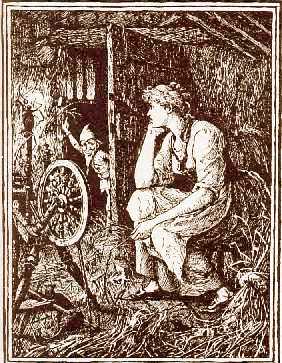
"She had no idea how straw could be spun into gold, and she grew more and more frightened, until at last she began to weep.  But all at once the door opened, and in came a little man..."
I'll try not to roll my eyes at why the miller's daughter didn't at least start trying to spin her straw, plead hay fever and demand release, or fess up to her father's lies; but as in many fairy tales, we have a male who comes to her rescue.  The stranger creates the gold in exchange for a necklace and when the king's greed causes a repeat of events the miller's daughter turns over a gold ring.  (Does anyone ever stop to wonder why, if the miller was so poor, does his daughter have a necklace and a ring that become some pretty hefty bargaining chips?  Or why, if Rumpelstiltskin can spin stray into gold, does he have need of the girl's trinkets?  Sorry, moving on.)  On the third night, the girl is once more thrust into a room of straw and told by the king, "You must spin this, too, in the course of this night, but if you succeed, you shall be my wife."

Rumpelstiltskin appears to save her once more but she is left without anything to offer him in trade for his service - and yet he offers her a deal:
"'Then promise me, if you should become queen, to give me your first child.'"
Who knows whether that will ever happen, thought the miller's daughter, and, not knowing how else to help herself in this strait, she promised the manikin what he wanted, and for that he once more spun the straw into gold."
I know fairy tale heroines are not known for their brains but since the king promised to marry her for one more night of spinning and if Rumpelstiltskin had already delivered a straw to gold transmogrification twice, why didn't she think she would be queen?  So the story proceeds with the girl marrying the king, and eventually having a child that Rumpelstiltskin comes to claim.  She pleads with him not to take the baby and he offers her a reprieve if she can guess his name.  (I have to wonder, how did he help her out three nights in a row and she never asked who he was?)  Of course the big "R" is not a name on anyone's lips so the new queen's situation is rather dire.  She sends out messengers to seek new names from all the kingdoms and eventually one returns with the following tale of what he observed:
"Round about the fire quite a ridiculous little man was jumping, he hopped upon one leg, and shouted -
     'To-day I bake, to-morrow brew,
     the next I'll have the young queen's child.
     Ha, glad am I that no one knew
     that Rumpelstiltskin I am styled.'" 
The queen reveals the answer to the guessing game and the peeved little man suffers a rather disastrous fate:
"...in his anger he plunged his right foot so deep into the earth that his whole leg went in, and then in rage he pulled at his left leg so hard with both hands that he tore himself in two."
Typically Grimm, that line is the morbid end to the story.  At first, my reaction to this story is one of disdain.  None of the characters are exceptionally virtuous, but on second look there are some actual morals to be found.  The first may be that honesty is the best policy and that one should not tell lies to make themselves seem more important, but I think the larger lesson revealed is to guard one's words.

There are multiple Biblical proverbs about this topic, and regardless of your thoughts on the divinity of scripture, the advice is exceptionally wise.  One example is Proverbs 13:3 "He who guards his lips guards his life, but he who speaks rashly will come to ruin." (18:21 says, "The tongue has the power of life and death" and 21:23 states, "He who guards his mouth and his tongue keeps himself from calamity.")  Knowing that the Grimms were in the practice of moralizing, I think it can be rather obvious how these verses tie into the tale.

Firstly, the father's boastfulness is what begins the whole fiasco.  The king's harsh threats cause the miller's daughter her panic, which in turn leads to her making an unwise promise to Rumpelstiltskin.  All through the story we see the characters causing their own trouble because of what they say and ultimately, it is the little man's words when he thinks no one can hear him that leads the queen to have his name. 


What are your thoughts on the morals and lessons of Rumpelstiltskin?  Is discretionary speech a good theme to pull out of this tale or do you interpret it differently?  Do you feel bad that things ended so poorly for the titular character or do you think he got what he deserved? 


This post marks another entry in my 2011 Fairy Tale Challenge (10 out of 12) hosted by Tif of Tif Talks Books.  I'd love for you to share your thoughts on this post or any of my previous Fairy Tale Fridays selections and wish me luck in finding two more tales to post about before year's end!

Pirate of My Heart (Happy Talk Like a Pirate Day!)

Yo ho, yo ho!  It be Talk Like A Pirate Day once more an' the only thing better than a bottle o' rum be a bottle o' rum and a piratey book to read!  Today the Dread Pirate Brody be bringin' ye a review o' Pirate of My Heart by Jamie Carie. 

Lady Kendra Townsend is left in a dire situation when her greedy uncle takes over her father's estate. Given the choice between being married off to a husband twice her age or being shipped off to live with relatives in America, Kendra chooses an unknown life overseas.

Captain Dorian Colburn has his own plans for the running of his new cargo ship and escorting Lady Kendra as a passenger to America was not one of them. At first he is annoyed by the inconvenience of the heiress aboard his ship but soon he finds his attraction to her an even larger distraction from his duties.

Set upon by pirates during their voyage and facing family conflicts and burdens of the past once they reach their destination, the relationship between Kendra and Dorian is far from simple. She is a woman of faith and turns to God during all her difficulties, and she is unsure if the ship captain fits into God's designs for her life. Though the element of Christianity is a turn-off for some, I thought it was dealt with really well as an aspect of Kendra's personality.

Yet, I would have preferred the book more had Kendra been a stronger heroine and relied less on Dorian to come to her rescue. I also thought more of the story was going to take place at sea, with pirates playing into a larger part of the plot. Nevertheless, this was still an enjoyable novel and I'd be willing to check out future works by Jamie Carie. 
Thar ye have it.  On top o' my review, I say I be lovin' the arrrt work on the cover o' this book.   The picture made me be thinkin' that it be a book more about pirates and seafarers than a tale o' love on land.  I be receivin' a copy o' this book on me Kindle for review from the ebook service by the name o' NetGalley -  I be thinkin there be a pirate ship lurkin' among their site but I've yet to find one!

Not sure if anyone else be celebratin' Talk Like a Pirate Day but it be a holiday I been bloggin' about fer many a turn o' the tides. Check out me review o' Treasure Island for more bookish pirate fun or spy The Dread Pirate Brody's Pirate Arrrrchives from me former blog. 

Unbroken

Laura Hillenbrand, author of Seabiscuit, relates another gripping and emotional biography in her latest book Unbroken. Subtitled A World War II Story of Survival, Resilience, and Redemption, Hillenbrand's work is exactly that.

Unbroken tells the story of Louis Zamperini. With humble beginnings as a neighborhood troublemaker in Torrance, California, Louis rose to the national spotlight as a runner in the 1936 Berlin Olympics. Barely missing a medal, he set his sights on the next Games, but like many, he delayed his dreams in order to serve his country and enlisted in the Armed Forces as a bombardier. His duty turned nightmare when his plane went down and survival on a raft drifting through the Pacific was only a sliver of torment compared to life as a POW in Japan.

Despite horrid and dehumanizing conditions, Zamperini survived, and his story is chronicled along with details of his family and fellow servicemen. Hillenbrand relies on primary sources and unfolds the story with an expert pen. Powerful, amazing, dramatic and inspiring barely scratch the surface of describing Zamperini's journey. I was captivated throughout the book and really enjoyed delving into this biography of an American hero of whom I was previously unfamiliar. This is a story of history and survival, but even more so it is a testimony to the power of the human spirit which in Zamperini's case, through the darkest times, remained Unbroken.

The Ear of Corn (Fairy Tale Fridays)

The Ear of Corn is a story by The Brothers Grimm that is more a fable or a legend than what I usually think of when I hear "fairy tale".  I've lived in the Midwest region of the United States my entire life so I'm no stranger to fields upon fields of corn which often are, as the saying goes, "knee high by the fourth of July".   And yet, I've never given much thought to the origins of corn.  It's something I just take for granted as having always been here.

At the same time, I love stories that involve how things came to be.  As a child I remember loving Just So Stories by Kipling and others in that same style - the ones that had fables of how the camel got his hump or why the elephant has a trunk and the giraffe a long neck.  I think The Ear of Corn story fits in with these types of origin tales.  The story relates how corn used to grow with multiple ears on a single stalk.  Because mankind didn't appreciate the plentiful nature of corn, God removed the crop and only returned it to it's single ear per stalk form after hearing cries from the people.

I really like the quote from this story that says,

"Men however are so made, that when they are too well off they no longer value the blessings which come from God, but grow indifferent and careless."

I think this is an interesting reminder about living life with a spirit of gratitude.  Often times on or around Thanksgiving and Christmas people talk about how blessed they are to have things like family, shelter, food, jobs, clothing, and other things that they otherwise take for granted.  I certainly won't speak out against this notice of life's everyday blessings, but why not make it a point to appreciate them every day, all year long?  Similarly, around the holidays people often take the time to recognize those less fortunate and give more to charity, participate in service projects, and make an effort to feed the hungry, clothe the naked and heal the sick.  Why not take these same steps to help others in January, April, and August?  I think this story makes a good point - that holds true today - about how we recognize blessings most when times are leanest.  I'm glad that we have a holiday in the US that's devoted to giving thanks, but I also wish that more people (regardless of religious or nonreligious affiliation) would take the opportunity to do so on a daily basis.  

What are your thoughts on this story?  Do you agree that people appreciate blessings less when they are well off?  Do you give thanks - and give to others - daily or only around the holidays?  Share your thoughts here or post your own Fairy Tale Fridays post and link up with Tif at Tif Talks Books!

Fairy Tale Fridays is a weekly meme hosted by Tif of Tif Talks Books.  Check out Tif's site for more information on upcoming Fairy Tales to read and discuss!

Bittersweet

Shauna Niequist, author of Cold Tangerines, returns to writing and her signature style of simple but poignant observations on faith in everyday life in her latest book Bittersweet. Subtitled thoughts on change, grace, and learning the hard way, Niequist does not shy away from discussing her own personal struggles and pain. Her candid honesty and conversational tone connects the reader to her words and her life making her message stronger, clearer, and more profound.

Each of the small chapters works as a stand-alone essay, but they all tie together smoothly. Whether reading one passage at a time or several in one sitting, the book has a smooth pace. Niequist is ultimately quotable, too; and I found myself dog-earring multiple pages knowing that there were several lines I wanted to come back and reflect on at a later time.

The title of the book comes from Niequist's idea that a full life requires both bitterness and sweetness. She says, "When life is sweet, say thank you and celebrate. And when life is bitter, say thank you and grow." In a later chapter about friendship and the trap of always trying to appear perfect she explains, "We slip into believing that it's better to strive for perfection than to accept and offer one another grace." And among many brilliant thoughts on writing she offers the insight, "Writing wakes me up, lights me on fire, opens my eyes to the things I can never see and feel when I'm hiding under the covers, cowering and consumed with my own failures and fears."

Niequist is not ashamed to share her "failures and fears" with the reader but it is obvious that what she states about writing is true. In the written word she truly does shine, and her words are perfectly chosen and powerful, creating a work to be reread, reflected on, and ruminated over long after the final page is turned.

Mercy Rising


Mercy Rising by Amber Robinson is true to its subtitle and involves Simple Ways to Practice Justice and Compassion. Aimed mostly at women, Robinson discusses practical ways of serving in everyday life including educating readers about organizations, opportunities, and websites that deal with combating poverty and other social justice issues, locally and internationally.

Drawing from her experiences as an advocate for Compassion International - a Christian child sponsorship organization - Robinson points out easy ways to help better the lives of others. Some of her suggestions seemed rather obvious (donating clothing) but others were new to me (searching websites that report on companies agreeing to stop human rights violations). Mercy Rising is a book that could be a valued resource to those taking the first steps towards justice around them as well as to those that have been making strides for years.

A friend of mine is fond of saying that to start serving others, people just need to get off their "buts" (But I'm too busy, But I don't have money, But I'm not good at that). Robinson takes this philosophy one step further and centers her book around the idea of each person starting with just "one thing". For anyone who's ever been overwhelmed at injustice in the world but doesn't think that one person can make a difference, Mercy Rising is a great place to look to have a change of heart and realize that even small steps can have a positive impact in the world.

A copy of this book was sent to me by the publisher in exchange for a review.  
This review represents my honest and unbiased opinions.

She Walks in Beauty

She Walks in Beauty by Siri Mitchell transports the reader to New York's Golden Age of the late 1800's. The story follows young and timid Clara Carter as she is thrust into the world of high fashion and elegance with her debut into society. While Clara would prefer to keep to herself and her books she feels duty bound to her father and aunt and submits herself to their rigorous tutelage and their hopes that she will secure a wealthy husband.

Though parts of the story in this book were predictable, I did find it to be an enjoyable read. The historic setting and details were well painted and it was an interesting look at the celebrity status that debutantes experienced at the time. Also, I felt that the Christian message was appropriate and fit into the story smoothly. Many readers complain about Christian fiction as being "preachy" and I don't think this book was. The theme was one of God loving people personally, just as they are, and it fit in well with Clara's struggles of maintaining a perfect appearance and always looking to please others.

Overall I think this book was a unique and engaging story. There was a subplot involving the contrast between the upper and lower classes in New York that I wish had been developed and expanded. However, the focus of the story was solidly on Clara and she was a charming heroine - modern enough to appeal to contemporary readers without seeming out of place in her setting. She Walks in Beauty is a solid entry into the genres of historical fiction and Christian fiction and Siri Mitchell shows herself to be an accomplished writer of both.

I'm curious where other readers fall in their opinions of Christian fiction; do you like books to have a strong Gospel message or do you prefer Christian themes to be woven in subtly?

Cold Tangerines

Cross Posted From Blogger Arrow:

My friend Ellen recommended a book to me called Cold Tangerines by Shauna Niequist. I didn't admit to her (until now) that I cringe a little at book recommendations. There's a certain amount of pressure that comes with reading a book that someone else really likes. Maybe the book spoke to them in a way that it just won't talk to you; perhaps something in a person's life resonates with the book and they only imagine that you share that sonorous quality. Whenever someone recommends a book I find myself reflecting on the quote that, "In literature, as in love, we are often astonished at what is chosen by others."

However, Ellen is someone that I trust and admire so her recommendation didn't dare go into the "perhaps, maybe before I die" pile of books on my mental shelf. Instead, Cold Tangerines showed up on my library hold queue and jumped quickly to the top. I started it this week, and (as of my train ride home today) I have just a few chapters remaining. It's the kind of book that speaks to a reader - I suppose I mean female readers - and I almost wish I could Xerox off different chapters and press them into the hands of family and friends and say "You need to read this!" or "This is SO what you are going through!"

And, of course, with a book that relevant to my loved ones, there were to be found several passages that seemed to be written directly at me. In a chapter called "Prayer and Yoga" she laments that both are decidedly good for her yet she doesn't stick to either as often as she should. (Sound like anyone you know??) I also really liked her thoughts on writing. As I contemplate another looming November with NaNoWriMo, I find myself pondering if I want to embrace - unleash - my identity as a writer once again. I've wavered and flip-flopped about taking on the chaotic novel-in-a-month challenge this year and then, this afternoon, I read this:

"Sometimes when I'm writing, if I try really hard, I can move more slowly, like a dancer or a mime, and taste things more vividly, and see not just the trees and the grass, but the individual leaves and blades. Things are richer and brighter than I thought, now that I have slowed down enough to see them."
~Shauna Niequist, Cold Tangerines p. 137

I don't think NaNoWriMo is quite the atmosphere for slowed down perception that Niequist is speaking of, but I understand her need for the reflective introspection that comes from times of writing. It's where I spent a lot of time in the days when I was a prolific journaler - heck, even when I was a more prolific blogger. I look with some shame on my sparse posting of this year. I see it not as sad because I missed sharing inane thoughts with friends and family but rather, sad that I was living my life without reflection.

There's a famous quote that says "We must live life forward and define it backward," but I think most of us fall into the trap of too much forward motion on that one. Not that it would be good to over-define life to the point of not spending one's time living it. When we can find the place between rushing out to live each day and poignantly reflecting on our journey as a whole, that's where a well paced life will be. Neither hurried nor bored, that will be a balanced life indeed.