Four Things...

In every bloggers life there comes a post that goes something along the lines of, "Sorry I haven't been posting very much."  This is that post.  So I thank you my (hopefully) faithful blaudience for sticking with me in a bit of a post shortage.  For those that only know me online, I should probably take a moment to reveal that I'm a book blogger by hobby but a research scientist by trade.  The past two weeks have marked one of the most taxing and intensive experiments of my career, hence if I've been providing less, or less-than quality posts, well, it's all in the name of science. 

I'd also like to extend an apology to any authors waiting for me to review their work.  If you're reading this, thank you for taking the time to stop by my blog even though I likely don't have a review for you yet.  Nevertheless, summer is nearly here and I do hope it will mean lots and lots and lots of reading time!
But aside from work which has me more than deserving the upcoming three-day-weekend, here's four things from my week that have kept me away from the blogosphere:

1. I got a haircut - my last cut was in November so my shaggy mane actually resembles a hairstyle again.

2. Went to see/hear Lee Strobel speak  - he just wrote a novel, The Ambition, and I got a signed copy!

3. Saw the new Pirates of the Caribbean movie - won't give anything away but it's my favorite since the first one... if you like the franchise, go see it!

4. Watched the Bulls lose to Miami - no offense Heat fans but if we disliked you before, we really hate you now. :(

 All in all it's been a good, but busy week.  As much as I've missed the simple act of writing posts, I've missed reading all my favorite blogs even more!   Hope everyone else has been doing well and proliferating posts better than I - looking forward to catching up!

The Replacement

This is one of those books.  You know, the kind you read because everyone's read(ing) it.  I first heard about The Replacement last fall, and as reviews came in from fellow bloggers, I was surprised to see such a huge variation in reviews from adoring fanfare to snarky trash talk.  A book that drew so wide a spectrum of opinions instantly became a book I had to read for myself.

Mackie Doyle is a replacement, or more specifically The Replacement.  He is a changeling left in the crib of the real Malcolm Doyle and few are privy to the truth of his real nature.  As a teenager Mackie struggles to appear normal while fighting against crippling allergies to iron, blood, and consecrated ground.  However, when more children in the town of Gentry begin dying - or more accurately disappearing with changelings left to die in their stead - Mackie must decide how much he values protecting his identity.  Straddling the worlds of human and fae, Mackie is in the unique position of belonging to both, or perhaps neither.

Brenna Yovanoff creates an interesting story in The Replacement.  Mackie was an intriguing narrator and I appreciated that this was a young adult work told from a male perspective.  The plot was creative and I liked the premise of a grown-up changeling.  That said, I partly wanted to see more glimpses into Mackie's life as a child.  There are a few flashbacks to when he was first switched into the Doyle family, but I found myself quite curious to learn more about his early childhood and the details of how his family and friends came to accept him.

The world of the fair folk was another good - but not quite great - aspect of the novel.  Mackie finds himself drawn into a rivalry between two fairy queens (though they are never named exactly as such) and he discovers truths about himself and the history of the town around him as he is pulled deeper into their world.  The back-story and mythology of this hidden realm is touched-on and partially explained, but again, I found myself wanting to know more about the details and depth of Yovanoff's landscape.

In short, I would say that I liked but did not love this book.  Many of the details of Mackie's life and world could have been developed and expanded to make the setting really come alive for the reader.  The conclusion wrapped up the story nicely but came across as a little too simple, but overall, as a young adult novel, The Replacement was an entertaining story with a creative plot and a unique perspective. 
So there you have it.  I came out rather lukewarm on this one.  I didn't adore it (as some did).  Nor did I hate it (as others did). It's not the best book I've read this year, but there are definitely aspects of it that I enjoyed.  Have you read The Replacement?  Where on the spectrum of opinions did you fall?  Do you ever read books just because they have a wide range of reviews?

Off with their heads! (A Weekend to ReCOVER)

A few years ago I read this book by Philippa Gregory:
On a recent trip to the library I also happened to notice that a few other Philippa Gregory covers had a really similar trend to them:
I'm not sure if this is a style started by Gregory (or her publisher), but what is the deal with cutting faces - or at least foreheads - from the covers of historical fiction books?!?? At first I thought it was confined to the Tudor era (an allusion to Henry VIII's passion for beheading people, perhaps?), but the pattern definitely goes before and beyond that time period. Take a look at a few examples I've noticed lately:


These are all from different authors and I'm not certain if they're at all inspired by each other, but I find it rather amusing that they follow the same trend of never venturing higher than a lady's eyes!  I could speculate that the period costumes are a more unique focus, but for the ones with photographs, the cover models all appear to be rather attractive women and I feel rather sorry for them that none managed to get their faces onto the book jackets.  Do they have oddly shaped eyebrows?  Did their hair never quite stay in place for the photo sessions?  I guess we'll never know...    

What are your thoughts on the headless historical trend?  

This post is part of a meme I host called A Weekend to Recover that focuses on discussing book art and cover comparisons.  Feel free to leave your comments below or link up with a post of your own!

A Clash of Kings

I think it's safe to say that anyone who is reading or has read A Clash of Kings thought well enough of the epic George R.R. Martin began in A Game of Thrones to continue the saga.  I can't very well picture someone trudging through book one, hating it, and saying, "Well, that was complete rubbish, why don't I try out another seven hundred pages of the same!"  A Clash of Kings is the book for those that devoured the relationships, battles, power struggles, alliances, and betrayals that began A Song of Ice and Fire and were more than eager to explore the second verse. 


Yet, A Clash of Kings is also likely to gain a new audience very soon.  HBO's series Game of Thrones follows the saga told in book one, and I predict that if the season ends with the same cliffhangers as the book, many watchers could be running to their local bookstore or library hungry for a continuation of the plot.  Some die hard fans may start reading at the beginning, but I expect that several fans will jump right from the show into book two.  (Quick note: I'm not currently watching the series but I have high hopes for it and may even plan a weekend DVD binge when it's released on disc.) 

The glorious thing about this arrangement is that Clash of Kings is equally as good as Game of Thrones.  HBO will serve to draw new readers to the epic series and even if they jump in at Clash, there is plenty to hook them and hold them through the next few tomes.  The story begins where Game left off with multiple individuals claiming crowns of their own.  And Martin's pattern of killing off those bearing titles of royalty continues - though I'll not say which or how many of the rulers survive through this volume.  There are favorite players that continue to shine, and new narrators whose perspectives cast new insight on leading characters.  Some are intriguing enough that the reader wants to hear more of their story and some are so vile that the reader hates to be inside their heads.  (Yes, Theon, I mean you!)

In short, A Clash of Kings is a worthy follow-up to A Game of Thrones.  In some ways, it could be seen as just more of the same, but that write-off minimizes the expansion and growth that Martin continues to pour into the series.  The unpredictable quality of the plot ensures that this is not a series for those looking to find a "Happily Ever After" at the end of the tale.  Rather, it is a series for those who don't want stories to end - for if A Clash of Kings promises anything it is that - even after 1000+ pages - A Song of Ice and Fire has only just begun!

Becky: The Life and Loves of Becky Thatcher

In Becky: The Life and Loves of Becky Thatcher, Lenore Hart weaves historical fiction and gentle romance into Mark Twain's classic The Adventures of Tom Sawyer, with the caveat that the heroine, Becky Thatcher, is not the sniveling girl Twain portrayed her to be. The story begins with a grown up Thatcher, married to Tom's cousin Sid Hopkins caring for two children with Hannibal, Missouri facing the effects of a country on the brink of civil war. Though satisfied with her life, Becky has fond recollections of her childhood days – in flashback scenes the reader is brought to a fun alternate narration of Tom Sawyer - and still nurses secret affections for her first sweetheart.

Hart’s novel plunges into adventure as the grown up Becky tries to save her husband from the war and convinces her family to follow the gold rush out to the Wild West. Along the way Samuel Clemens (the writer who adopts the pen name Mark Twain), Huck Finn, Jesse James, and, of course, Tom Sawyer make their way into Becky’s tale enhancing the feeling that the book is a true account of a fictional character’s life. Hart writes a believable story while maintaining a sort of southern charm that keeps it true to the spirit Twain’s novels.

I really enjoyed this book.  As a fan of Tom Sawyer and Huckleberry Finn, Becky seemed to me the book that could’ve been written if Mark Twain was a woman. I was enamored with the characters by the very first page and would recommend the book to those that love Twain’s writing as well as any fans of historical romance. At times sweet, funny, tender, sad, poignant and exciting, Becky:The Life and Loves of Becky Thatcher earns a rightful place on a shelf near classics that inspired it.

The Girl Who Was on Fire

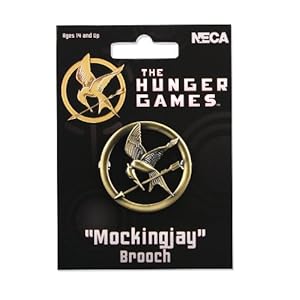
You too can wear Katniss' pin!
I tend to be a bit of an avoidest when it comes to reading popular fiction.  I was unimpressed with The Da Vinci Code, I'm turned off by Oprah's Book Club labels, and I  have yet to touch Stieg Larsson's Millennium Trilogy.  I don't really think of myself as a book snob, I just try to avoid things that come with a lot of hype.  My reading is pretty expansive so when a certain work garners a lot of mass attention, I usually figure that my lone voice won't add a lot to the discussion.  People generally love it so does it matter if I do or don't? But sometimes a book that captures the critics praises sounds right up my alley.  Even though I don't always enjoy being part of the crowd, occasionally I'll be a bandwagonner.  So it was with The Hunger Games.  I devoured Suzanne Collins' young adult dystopia series last year (see my reviews of The Hunger Games and Mockingjay) and like many, I've been eagerly buzzing around rumors and announcements about the upcoming movie.

So the question is, why, after reading this series almost a year ago, am I still so captivated by it?  Why do I still reflect on the culture and world Collins created in her books?  Why is Panem - with all its inhabitants - remaining on the fringes of my thoughts?

Because the books are good.  That's the simple answer.  The more complex response?  Because great dystopia creates a world that not only speaks of a dark and distant future but also reveals the nearness of that darkness in existing society.  Because Collins wrote books that provoke thought and challenge the reader beyond the story.  Because all the best books stay with you after you read them.  And a group of young adult authors realized this.  They took their thoughts and compiled a series of essays exploring why and how The Hunger Games series managed to capture the hearts and minds of a generation of readers both young and old.

The book is The Girl Who Was on Fire: Your Favorite Authors on Suzanne Collins' Hunger Games Trilogy and it's a nonfiction compilation edited by Leah Wilson.  The essays range in scope from exploring the popularity and general appeal of the series to exploring some of the deeper and more mature themes of politics and society within Collins' writing.  As with any conglomerate work, some are better than others, but overall the book makes an excellent read for any Hunger Games aficionados.  The works included in the book are:

  • Why So Hungry for the Hunger Games? Or the Game of Making Readers Hungry for More, Why Readers' Imaginations Caught Fire, and My Sad Inability to Come Up With a Wordplay for Mockingjay by Sarah Rees Brennan
  • Team Katniss by Jennifer Lynn Barnes
  • Your Heart is a Weapon the size of your Fist: Love as a Political Act in the Hunger Games by Mary Borsellino
  • Smoke and Mirrors: Reality vs. Unreality in the Hunger Games by Elizabeth M. Rees
  • Someone to Watch Over Me: Power and Surveillance in the Hunger Games by Lili Wilkinson
  • Reality Hunger: Authenticity, Heroism, and Media in the Hunger Games by Ned Vizzini
  • Panem et Circencses: The Myth of Real in Reality TV by Carrie Ryan
  • Not So Weird Science: Why Tracker Jackers and Other Mutts Might Be Coming Soon to a Lab Near You by Cara Lockwood
  • Crime of Fashion by Terri Clark
  • Bent, Shattered, and Mended: Wounded Minds in the Hunger Games by Blythe Woolston
  • The Politics of Mockingjay by Sarah Darer Littman
  • The Inevitable Decline of Decadence by Adrienne Kress
  • Community in the Face of Tyranny: How a Boy with a Loaf of Bread and a Girl with a Bow Toppled an Entire Nation by Bree Despain
One of the brilliant things about Collins' books is how she brought heavy topics to young readers in an easily accessible manner.  This collection of essays is the book for those readers that want to dig deeper into these topics and delve into a further analysis on the trilogy.  The Girl Who Was On Fire is perfect as an addition to a book club, for the casual philosophy fan, or anyone who just can't get enough of The Hunger Games

Characters You Love to Hate (Top Ten Tuesday)

It's been a while since I participated in Top Ten Tuesday, but welcome (or welcome back) to this fun feature hosted by one of my favorite book blogs The Broke and The Bookish!  This week's topic is The Biggest Jerks in Literature.  I've come up with nine loathsome characters so let me know which you think is the biggest jerk of the bunch or weigh in with your own choice for the not-so-coveted tenth spot!

(And again, these are in no particular order.  There are definitely some that are more wretched than others, but I certainly would not want to interact with any of them in real life.)

1. Theon Greyjoy from A Clash of Kings by George R.R. Martin.  I know Theon is on this list due to the Recency Effect (I finished my reread of Clash of Kings last week), but he certainly earns his place.  Those who have only read book one or are following the Game of Thrones TV series, might not think much of Eddard Stark's ward, but he becomes a more prominent character in book two - with his own chance at chapter narration - and the peek inside his head is not a pretty sight.

Joffery played by Jack Gleeson
2. Joffery Baratheon from A Game of Thrones by George R.R. Martin.  There really is no lack of villainous characters in Martin's books so in a way it's hard to only pick one other character from the Song of Ice and Fire series, but I had to go with Joffery.  He's spoiled, arrogant, stubborn, cruel, snotty, rude, disrespectful - and the only thing that could make that combination worse is to wrap all those character traits up into someone who wields a great deal of power.

3. Edward Cullen from New Moon by Stephanie Meyer.  I may get some flak for this choice, but I'm going to stand by it.  The whole Edward-Bella relationship has a load of problems overall, but the part of it that irked me most was always Edward's behavior in book two.  Most of his actions seem drawn more for plot convenience than from character composition and especially in New Moon, I think he qualifies as a jerk. 

4. Assef from The Kite Runner by Khaled Hosseni.  Do I even need to explain this choice?  I shudder to even mention his name on this blog - truly a character that made me sick to my stomach.

5. Draco Malfoy from the Harry Potter series by J.K. Rowling.  I'll admit that Draco became a more interesting character as the books progressed, but I still think he counts as a literary jerk.  From his very first interactions with Harry and Ron, Draco is painted as a villain and I know plenty of us cheered when Hermione slugged him.

6. George Wickham from Pride and Prejudice by Jane Austen.  I suppose the term for Wickham is "rogue" more so than "jerk" but the fact that he is a bit of a wolf in sheep's clothing earns him a place on my list.  If he were an outright cad he might be less reprehensible, but the fact that he acts the gentleman while playing others falsely is what I find most infuriating about him!

7.  Gale Hawthorne from Mockingjay by Suzanne Collins.  This one might get me in even more trouble than Edward Cullen but hopefully Team Gale will hear me out.  I think Gale could have been a much better guy in this book.  He professes to love Katniss but throughout the book I don't know that he ever really listened to her or cared about her feelings.  Toss in his moral ambiguity and - at least in Mockingjay - he makes my list. 

8. August Rosenbluth from Water for Elephants by Sara Gruen.  Again, I probably don't need much explanation here.

9. Bob Ewell from To Kill a Mockingbird by Harper Lee.  Bob Ewell's not a character name that usually jumps to mind when people think of Harper Lee's classic - Scout, Atticus, Jem, Dill, Boo might be more familiar - but Mr. Ewell is Mayella Violet Ewell's father, and for those a bit rusty on the story, Mayella is the plaintiff in Tom Robinson's trial.  Bob Ewell takes the crown for despicable characters for his racism and bad parenting, but he tops this list because Harper Lee didn't pull his character out of thin air.  He's fictional, yes, but he's also a frighteningly true character; and Harper Lee's ability to realistically capture characters possessing hardened hatred alongside those with unconquerable innocence is part of what makes her work a masterpiece. 

Again, I'll leave number 10 up to everyone else.  Feel free to debate my choices or add in your own pick, and if you've posted a list on your own blog, drop me a link and I'll be sure to stop by and see it!

Melisande (Fairy Tale Fridays)

I realize that I'm catching the tail-end of this one (May 2-8), but I didn't want the week to pass completely without taking the time to focus on a great book that's a fun read for kids of all ages.

Melisande by E. Nesbit is a great fairy tale story including a princess, a host of fairies, magic wishes, and several other classic bedtime story elements.  However, this is also a story that takes a few twists from the predicted path and plays upon traditional fairy tale cliches. The whole story is available here, but the illustrated version is an even more delightful read. 

Melisande is a princess born to a rather wise king and a very typical queen.  In discussing their daughter's christening party, the royal couple decides not to have a celebration since whenever a fairy is not invited - and one among the many is inevitably always forgotten  - that fairy places a curse on the child.  The parents' decision rather than pleasing the fae of the kingdom serves to anger them all.  Luckily, Melisande survives with only a single curse placed upon here - she is bald.  The young child grows up to be exceedingly kind and lovely and has very little regret of missing locks, but as she ages her mother decides she should have hair.

Using an overdue wish from her father's fairy godmother, Melisande wishes for hair and on her mother's urging gains a golden yard which grows an inch every day and grows twice as fast every time it is cut.  The wise king is the only one who initially sees folly in this wish as, "he had a mathematical mind, and could do the sums about the grains of wheat on the chessboard, and the nails in the horse's shoes, in his Royal head without any trouble at all."  And Melisande's ever growing hair becomes not just a source of amusement in the tale, but a great lesson in numbers for young learners as well!

As the gift becomes quite unmanageable, princes are summoned to the kingdom to solve the hairy dilemma (couldn't resist!), one comes up with the solution to not cut the hair off the princess but to cut the princess off the hair!  What seems an ingenious answer soon proves equally problematic, and once again it is the king who sees why.

"Humph!" said the King, who had a logical mind. And during breakfast he more than once looked anxiously at his daughter. When they got up from breakfast the Princess rose with the rest, but she rose and rose and rose, till it seemed as though there would never be an end of it. The Princess was nine feet high.
"I feared as much," said the King, sadly. "I wonder what will be the rate of progression. You see," he said to poor Florizel, "when we cut the hair off, it grows — when we cut the Princess off, she grows. I wish you had happened to think of that!"
I won't give away the ending of the story (and only said as much as I did because of the cover image with a rather giant princess) but it really is a clever and charming tale.  For young fans of the recent Disney hit movie Tangled, Melisande is a great story with a similar long-hair problem as Rapunzel and with humorous twists and turns to be encountered as it is solved.

Along with celebrating the joy of young readers during Children's Book Week, this story is also part of my 2011 Fairy Tale Challenge (5 of 12) begun by Tif at Tif Talks Books.  Feel free to share your thoughts about Melisande in the comments section or link up with your own post featuring your favorite Children's Book or Fairy Tale!